domingo, 1 de septiembre de 2019

Keys to developing healthy and emotional bonds in the classroom:


Affection is the basis of the emotional and intellectual health of every human being. Social relationships such as family relationships are more harmonious and satisfying the greater the warmth that sustains them.
The benefits of creating emotional bonds in the classroom are numerous. These relationships are channeled through two types of links: the one between teacher-student and the one between student-student. The sum of the quality of these two will determine the type of behavior that will classify the class.
Link is a "way of relating." There are many ways to link, as many as people in the world. Here are some keys to develop healthy and emotional bonds in the classroom.
Teacher-student link:
-It must be horizontal and not hierarchical. The teacher listens to the child's arguments and feelings.
-The authority without affection does not work. The influence on the child must be based on affection and not fear. It is necessary that he feels loved and accepted, only then will he integrate the rules of conduct, values and contents in a profound way.
-The teacher is a model of social relations and not only a transmitter of knowledge.
-The communication between both contains caresses, gestures and words of affection.
Student-student link:
The teacher encourages:
The development of intimacy through the expression of thoughts and feelings in the group.
Taking care of values such as trust, respect and tolerance.
The promotion of the sense of humor looking for moments for laughter and relaxation.
Elección:
Considero fundamental construir un ameno, cariñoso y acogedor clima áulico para la adquisición de saberes, en tanto, el vínculo entre docente-alumno será primordial e imprescindible para cumplir con dicho objetivo.
Yensy Piedra.


Technology innovation in education research

South African Journal of Education


Technology innovation in education research

The globalization and digital environment are essential characteristics of today's rapidly changing world. Inevitably, learning and teaching facilities are under the impact of such changes. As indicated by O'Reilly (2005), web 2.0 tools have become popular. Such tools make use of social networking sites like Twitter and Facebook in addition to Wikipedia and YouTube in which visitors can contribute to the content of the web sites. Previously, individuals' intention when using the Internet may simply have been to surf in order to retrieve information. Such a one-way communication facility requires little interaction with the content of a web page. However, with the democratisation of the Internet web 2.0 tools now provide social connection and allow Internet users to take part in the presentation of materials - such as uploading photos and videos along with publishing personalised blogs and messages by means of social networking sites. The advantages provided by social media and web 2.0 tools may also contribute to contemporary educational facilities. Although this seems to be advantageous in terms of providing alternative education facilities, the long-term implications of such interactions require investigation.
Inquiry into the education implications of technological developments promises interesting knowledge contributions for a range of education-related domains. For instance, the simplicity of retrieving information from the Internet has increased concerns related to plagiarism in learners' assignment submissions (e.g. Sentleng & King, 2012). Consequently online plagiarism detectors, such as Turnitin, emerged as prominent quality assurance structures in assessment.
Educational research is also required to interrogate the intersections of design needs for innovative and effective learning environments. Technological developments seem to have both simplified and complicated instructional processes and experiences of teachers and students. Instructional technologies used in classrooms have to align with the dynamic trend of change synonymous with a technological era. The use of interactive boards is one such example. In a neo-liberalist marathon, schools compete to replace outdated blackboards with popular interactive boards (Beauchamp, 2004). To effectively benefit from such instructional technologies, teachers need evidence-based training about the utility of interactive boards.
Another technological innovation used in instruction is smart phones - used by both teachers and students. These portable devices provide accessible learning facilities to students. The function of mobility, providing intensive and extensive learning opportunities, may hold a significant advantage for education innovation (Yang, 2013). As in the case with interactive boards, rigorous studies are required to disseminate knowledge on the efficacy and utility of smart phones for education.
Within the scope of these discussions, this special issue aims to bring together scholars with expertise in a variety of fields in order to investigate the notion of 'technology innovation in education research' to contribute knowledge on the intersection between technological innovation and related education theory, practice and policy. Interested researchers are expected to disseminate evidence-based knowledge that sheds light on the application of cutting-edge instructional technologies in education. Related studies may investigate learning and teaching assisted by instructional technologies.


Ideas principales:

El artículo trata del aumento del desarrollo de la tecnología a nivel mundial principalmente con la utilización de la Internet y la incidencia que esto tiene en la educación. Gran ventaja: detector de plagio en trabajos académicos, dando una garantía en cuanto a la calidad de la evaluación.
Inserción de teléfonos inteligentes en los centros educativos utilizados por estudiantes y profesores que pueden ayudar en diversas oportunidades de aprendizaje. 
Este artículo trata de contribuir con el conocimiento sobre la intersección entre la innovación tecnológica y la teoría de la educación relacionada, práctica y política.

¿Por qué lo elegí?

Elegí este artículo debido a que es de suma importancia en materia educativa estar actualizados con las herramientas didácticas, ya que se puede adaptar la tecnología en los procesos de enseñanza. Lo cierto es que las TIC captan en gran medida la atención del alumnado.

Mariana Habiaga 
10 Practical resources to encourage the creativity of your students.


Why does the school kill the creativity of your students? What responsibility do you have as a teacher in the creative process of your students? Do you encourage creativity when you teach? This is not the first article in which I refer to the importance of creativity in the classroom. A creativity of which you as a teacher forms an essential part. But what is meant by creativity?


What is meant by creativity? What is your responsibility as a teacher?
The Royal Academy of Language defines the term creativity as the ‘faculty of creating‘. And what is creating? Well, for SAR, creating means ‘producing something out of nothing‘. If you look closely at the definition, you will realize that creativity begins and ends in the student himself. It is the student who is responsible for creating precisely from nothing. So, what role do you have as a teacher in the creativity process of your students? Well a lot. Let me explain it to you.

As a teacher you have the enormous responsibility of promoting the creativity of your students. And creativity is not encouraged by explaining and teaching. Creativity is encouraged:

By asking the questions that favor the best answers.
Posing problems whose solution can be solved by your students.
Showing the tools that will lead to the creation of something from nothing.
Boosting the individual talent of each student in your group.
Worrying about the interests of your students.
Stimulating curiosity.
Making each and every one of the teaching-learning processes functional, useful and real.
What can you do as a teacher to increase the creativity of your students?
1. Change the role of the student for the teacher. Have your students create a video of less than three minutes in which they explain with their words the content you are teaching them and upload it to a platform so they can consult it, such as Moodle.

2. Make an object that the student can give a utility. In turn, have an instruction manual invented.

3. Invent words and give them a meaning. Use them in your teaching sessions. You can also play to spell them. Create a code that only you and your students know. Create a dictionary.

4. Create a board game with content that you have worked in class. For example, a goose of verb tenses.

5. Make an exclusive coin for your class. Use it as gamification for your teaching sessions.

6. Create an animal that does not exist from the union of two animals they know. Work with this animal aspects related to the area of ​​science, for example, or have a legend or a story invented.

7. Change the name of your students during a Didactic Unit for the concepts that appear in the topic. For example, they can be historical figures in which each student or group should look for information to better know who it represents.

8. Have your students bring an everyday object from their homes and from this object ask them to look for another object that looks like it. From there you can work aspects of literary language such as comparison, image and met
aphor. Regarding how to teach the comparison, the image and the metaphor I refer you to the reading of the article on this link.

9. Have each student explain what is good for them. Exploit that talent individually to show it in front of the whole class. Try also that the talent is related to the content of the didactic unit.

10. Take a fragment of a movie and have a new dialogue invented that attempts to incorporate the contents of the Teaching Unit you are teaching. You can use tools for subtitling.

In conclusion.

As a teacher you have thought that your job is to teach in the best possible way. I believe that one more step must be taken. You have to teach in the best possible way, but always focusing your teachings from creativity. A creativity that you have not been taught, a creativity that is acquired from reflection. A creativity that does not appear in textbooks, but is very close to you. Moreover, it is within you.

It is better to create than to learn. Creating is the true essence of life, Barthold Georg

SOURCE: http://auladeideas.com/blog/2014/10/08/10-practicos-recursos-para-fomentar-la-creatividad-de-tus-alumnos/ed
8/10/2014
Carolina Varela.

Leading SDG 4 - Education 2030

10 global megatrends facing education

  • 30 January 2019
What are the big international trends coming over the horizon that are going to affect education systems around the world?
Andreas Schleicher, head of education for the OECD economic think thank and in charge of the international Pisa tests, sets out the biggest social, economic, political and technological questions being asked of schools around the world.
1. Wealth gap versus social mobility: The gap between the richest and poorest is widening, with more intense pockets of extreme privilege and deprivation. This inequality ends up on the doorsteps of schools. In OECD countries, the richest 10% have incomes 10 times greater than the 10% poorest.
Such division is one of the biggest challenges for education systems. How will such economic inequality be balanced against calls for schools to offer fair access to opportunity?
2. Rise of the Asian consumer: It might not be shared evenly, but there is rising affluence, particularly in Asia. The global middle class is getting bigger - and 90% of the new entrants will be in China and India. How will the global economy change when the most educated populations are from Asia, not North America and Europe?

What values will these newly-wealthy consumers want from their schools? Will universities be ready to expand to meet a much bigger demand?
3. Migration on the increase: There are a lot more people on the move, with Asia replacing Europe as the most popular destination for migrants. This mobility brings cultural diversity and the energy and ambitions of new arrivals, but it also brings challenges.
How should schools support pupils arriving from around the world? What questions does it raise about identity and integration? Will schools have a bigger role in teaching about shared values?
4. Show us the money: Funding pressures will be a big issue for education systems. There will need to be long-term spending decisions on schools, particularly when demands and expectations are rising. Who should pay for more students going to university? And what happens when funding levels have to be cut?
Individuals will also need to learn the financial risks of sudden economic shocks or long drawn-out recessions, particularly when household debt is rising.
5. Learning versus the echo chamber: Digital technology can connect people as never before, building links between countries and cultures. Or at least that's the theory. It can also make the world more volatile and uncertain. It encourages democracy by allowing voices to be heard, but then it concentrates unprecedented amounts of power in a small number of hands.
When news and information is customised for us by algorithms, it can leave people only hearing like-minded opinions, insulated against opposing views. How will schools and universities navigate a more open approach to ideas?
6. First class humans or second class robots?: There have been plenty of warnings about artificial intelligence threatening jobs. But education systems will need to equip young people with the skills that can be adapted and updated for a changing jobs market.
There will be far-reaching questions about how to develop human talents that can't be replicated by machines. How do we make sure that human qualities such as imagination, a sense of responsibility and emotional awareness are harnessed alongside the processing power of artificial intelligence?
7. Lessons for life: Life expectancy is increasing and a less predictable jobs market means adults are increasingly likely to need to re-train. Much more attention will have to be paid to lifelong learning, so that people are equipped to change jobs and for a much longer retirement. Since 1970 the average number of years of retirement in the OECD has risen from 13 to 20 years.
These decades have seen big changes in the workplace and a disappearance of a "job for life". But at present, those who need adult education and training the most, the low skilled, are currently the least likely to receive it. It's a problem that's too often been ignored, but it will become increasingly important for people's skills to be aligned with the jobs available.
8. Online or offline?: The internet is an integral part of young people's lives. In some countries the amount of time spent online by 15 year olds has effectively doubled in three years. Many teenagers say they feel bad if disconnected from the internet.
But education still has to come to terms with this permanent online presence. What part should it play in learning? How can its negative impacts be reduced, such as cyberbullying or loss of privacy?
9. Teaching values. Everyone expects schools to teach values, but in an increasingly polarised world who decides which values should be taught? The digital world has allowed more people to voice their opinions, but this is no guarantee they can access reliable and balanced information, or be willing to listen to others.

How can citizens sort fact from fiction? How should schools teach the difference between opinion and objective information? Is it the job of schools to be politically neutral or to promote specific ideas or ways of thinking? And what kind of civic virtues do modern democracies require?
10. Not even at the starting point. For hundreds of millions of the world's poorest children, particularly in sub-Saharan Africa, these issues will be irrelevant, because they do not even have access to school places or are in schools of such low-quality education that children leave without even the most basic literacy or numeracy.
Despite global pledges and warnings about the social and economic waste, the UN says there are about 260 million missing out on primary and secondary school.

Posted by Caterin Sugo

Technology Changing How Students Learn, Teachers Say.


Technology Changing How Students Learn, Teachers Say.


                                               Lisa Baldwin, a chemistry teacher, works with her students to fight through academic challenges.
Cr
edit                                                                                       Nancy Palmieri for The New York Times


There is a widespread belief among teachers that students’ constant use of digital technology is hampering their attention spans and ability to persevere in the face of challenging tasks, according to two surveys of teachers being released on Thursday.
The researchers note that their findings represent the subjective views of teachers and should not be seen as definitive proof that widespread use of computers, phones and video games affects students’ capability to focus.
Even so, the researchers who performed the studies, as well as scholars who study technology’s impact on behavior and the brain, say the studies are significant because of the vantage points of teachers, who spend hours a day observing students.
The timing of the studies, from two well-regarded research organizations, appears to be coincidental.
One was conducted by the Pew Internet Project, a division of the Pew Research Center that focuses on technology-related research. The other comes from Common Sense Media, a nonprofit organization in San Francisco that advises parents on media use by children. It was conducted by Vicky Rideout, a researcher who has previously shown that media use among children and teenagers ages 8 to 18 has grown so fast that they on average spend twice as much time with screens each year as they spend in school.
Teachers who were not involved in the surveys echoed their findings in interviews, saying they felt they had to work harder to capture and hold students’ attention.
“I’m an entertainer. I have to do a song and dance to capture their attention,” said Hope Molina-Porter, 37, an English teacher at Troy High School in Fullerton, Calif., who has taught for 14 years. She teaches accelerated students, but has noted a marked decline in the depth and analysis of their written work.
She said she did not want to shrink from the challenge of engaging them, nor did other teachers interviewed, but she also worried that technology was causing a deeper shift in how students learned. She also wondered if teachers were adding to the problem by adjusting their lessons to accommodate shorter attention spans.
“Are we contributing to this?” Ms. Molina-Porter said. “What’s going to happen when they don’t have constant entertainment?”
Scholars who study the role of media in society say no long-term studies have been done that adequately show how and if student attention span has changed because of the use of digital technology. But there is mounting indirect evidence that constant use of technology can affect behavior, particularly in developing brains, because of heavy stimulation and rapid shifts in attention.
Kristen Purcell, the associate director for research at Pew, acknowledged that the findings could be viewed from another perspective: that the education system must adjust to better accommodate the way students learn, a point that some teachers brought up in focus groups themselves.
“What we’re labeling as ‘distraction,’ some see as a failure of adults to see how these kids process information,” Ms. Purcell said. “They’re not saying distraction is good but that the label of ‘distraction’ is a judgment of this generation.”
The surveys also found that many teachers said technology could be a useful educational tool. In the Pew survey, which was done in conjunction with the College Board and the National Writing Project, roughly 75 percent of 2,462 teachers surveyed said that the Internet and search engines had a “mostly positive” impact on student research skills. And they said such tools had made students more self-sufficient researchers.
But nearly 90 percent said that digital technologies were creating “an easily distracted generation with short attention spans.”
Similarly, of the 685 teachers surveyed in the Common Sense project, 71 percent said they thought technology was hurting attention span “somewhat” or “a lot.” About 60 percent said it hindered students’ ability to write and communicate face to face, and almost half said it hurt critical thinking and their ability to do homework.
There was little difference in how younger and older teachers perceived the impact of technology.
“Boy, is this a clarion call for a healthy and balanced media diet,” said Jim Steyer, the chief executive of Common Sense Media. He added, “What you have to understand as a parent is that what happens in the home with media consumption can affect academic achievement.”
In interviews, teachers described what might be called a “Wikipedia problem,” in which students have grown so accustomed to getting quick answers with a few keystrokes that they are more likely to give up when an easy answer eludes them. The Pew research found that 76 percent of teachers believed students had been conditioned by the Internet to find quick answers.
“They need skills that are different than ‘Spit, spit, there’s the answer,’ ” said Lisa Baldwin, 48, a high school teacher in Great Barrington, Mass., who said students’ ability to focus and fight through academic challenges was suffering an “exponential decline.” She said she saw the decline most sharply in students whose parents allowed unfettered access to television, phones, iPads and video games.
For her part, Ms. Baldwin said she refused to lower her expectations or shift her teaching style to be more entertaining. But she does spend much more time in individual tutoring sessions, she added, coaching students on how to work through challenging assignments.
Other teachers said technology was as much a solution as a problem. Dave Mendell, 44, a fourth-grade teacher in Wallingford, Pa., said that educational video games and digital presentations were excellent ways to engage students on their terms. Teachers also said they were using more dynamic and flexible teaching styles.
“I’m tap dancing all over the place,” Mr. Mendell said. “The more I stand in front of class, the easier it is to lose them.”
He added that it was tougher to engage students, but that once they were engaged, they were just as able to solve problems and be creative as they had been in the past. He would prefer, he added, for students to use less entertainment media at home, but he did not believe it represented an insurmountable challenge for teaching them at school.
While the Pew research explored how technology has affected attention span, it also looked at how the Internet has changed student research habits. By contrast, the Common Sense survey focused largely on how teachers saw the impact of entertainment media on a range of classroom skills.
The surveys include some findings that appear contradictory. In the Common Sense report, for instance, some teachers said that even as they saw attention spans wane, students were improving in subjects like math, science and reading.
But researchers said the conflicting views could be the result of subjectivity and bias. For example, teachers may perceive themselves facing both a more difficult challenge but also believe that they are overcoming the challenge through effective teaching.
Pew said its research gave a “complex and at times contradictory” picture of teachers’ view of technology’s impact.
Dr. Dimitri Christakis, who studies the impact of technology on the brain and is the director of the Center for Child Health, Behavior and Development at Seattle Children’s Hospital, emphasized that teachers’ views were subjective but nevertheless could be accurate in sensing dwindling attention spans among students.
His own research shows what happens to attention and focus in mice when they undergo the equivalent of heavy digital stimulation. Students saturated by entertainment media, he said, were experiencing a “supernatural” stimulation that teachers might have to keep up with or simulate.
The heavy technology use, Dr. Christakis said, “makes reality by comparison uninteresting.”


Writed by: Matt Richtel.


Student: Micaela Caracó 4°A.

miércoles, 28 de agosto de 2019

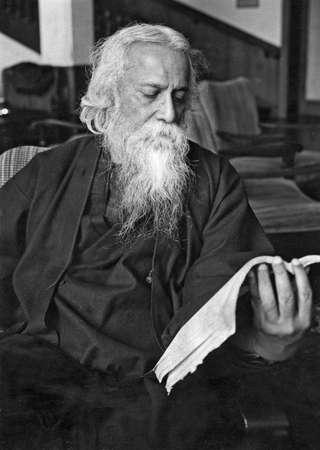
Rabindranath Tagore

Rabindranath Tagore
BENGALI POET
WRITTEN BY: 
LAST UPDATED: Aug 3, 2019 See Article History
Alternative Title: Rabīndranāth Ṭhākur
Rabindranath Tagore, Bengali Rabīndranāth Ṭhākur, (born May 7, 1861,
Calcutta [now Kolkata], India—died August 7, 1941, Calcutta), Bengali poet,
short-story writer, song composer, playwright, essayist, and painter who introduced
new prose and verse forms and the use of colloquial language into Bengali
literature, thereby freeing it from traditional models based on classical Sanskrit. He
was highly influential in introducing Indian culture to the West and vice versa, and
he is generally regarded as the outstanding creative artist of early 20th-century
India. In 1913 he became the first non-European to receive the Nobel Prize for

The son of the religious reformer Debendranath Tagore, he early began to write
verses, and, after incomplete studies in England in the late 1870s, he returned to
India. There he published several books of poetry in the 1880s and completed
Manasi (1890), a collection that marks the maturing of his genius. It contains
some of his best-known poems, including many in verse forms new to Bengali, as
well as some social and political satire that was critical of his fellow Bengalis.
In 1891 Tagore went to East Bengal (now in Bangladesh) to manage his family’s
estates at Shilaidah and Shazadpur for 10 years. There he often stayed in a
houseboat on the Padma River(the main channel of the Ganges River), in close
contact with village folk, and his sympathy for them became the keynote of much
of his later writing. Most of his finest short stories, which examine “humble lives
and their small miseries,” date from the 1890s and have a poignancy, laced with
gentle irony, that is unique to him (though admirably captured by the director
Satyajit Ray in later film adaptations). Tagore came to love the Bengali countryside,
most of all the Padma River, an often-repeated image in his verse. During these
years he published several poetry collections, notably Sonar Tari (1894; The
Golden Boat), and plays, notably Chitrangada (1892; Chitra). Tagore’s poems are
virtually untranslatable, as are his more than 2,000 songs, which achieved
considerable popularity among all classes of Bengali society.
Rabindranath Tagore.
In 1901 Tagore founded an experimental school in rural West Bengal at
Shantiniketan (“Abode of Peace”), where he sought to blend the best in the
Indian and Western traditions. He settled permanently at the school, which
became Visva-Bharati University in 1921. Years of sadness arising from the
deaths of his wife and two children between 1902 and 1907 are reflected in
his later poetry, which was introduced to the West in Gitanjali (Song
Offerings) (1912). This book, containing Tagore’s English prose translations of
religious poems from several of his Bengali verse collections, including
Gitanjali (1910), was hailed by W.B. Yeats and André Gide and won him the
Nobel Prize in 1913. Tagore was awarded a knighthood in 1915, but he repudiated
it in 1919 as a protest against the Amritsar (Jallianwalla Bagh) Massacre.
From 1912 Tagore spent long periods out of India, lecturing and reading from his
work in Europe, the Americas, and East Asia and becoming an eloquent
spokesperson for the cause of Indian independence. Tagore’s novels in Bengali
are less well known than his poems and short stories; they include Gora (1910)
and Ghare-Baire (1916), translated into English as Gora and The Home and the
World, respectively. In the late 1920s, when he was in his 60s, Tagore took up
painting and produced works that won him a place among India’s foremost
contemporary artists.

Motivo de la elección: En uno de los textos que trabajamos en el curso se hizo referencia a Rabindranath Tagore, de forma muy escueta, pero suficiente para que la teacher nos dijera una frase de él muy bonita. La reproduzco aquí: Yo dormía y soñé que la vida era alegría. Me desperté y vi que la vida era servicio. Serví y comprendí que el servicio era alegría. 
Esta frase algo tiene que ver con la docencia, sin dudas, pero más aún con la vida misma.
¿Qué decir de él? Recibió el premio nobel, pero no creo que los reconocimientos hayan tenido un lugar preponderante en su vida.

PD: Por fin entendí de donde venía el segundo nombre de Óscar, mi vecino...Óscar Rabindranath, pero Silva, no Tagore. 

Estudiante: Carlos García.

INSTRUCTIONAL TECHNOLOGY

INSTRUCTIONAL TECHNOLOGY Source : https://www.funderstanding.com/educators/instructional-technology/ April 15, 2011 DEFINITION      ...